
Welcome to the DirectDemocracyS system. To view all the public areas of our website, simply scroll down a little.

Blog
Programme for Kosovo

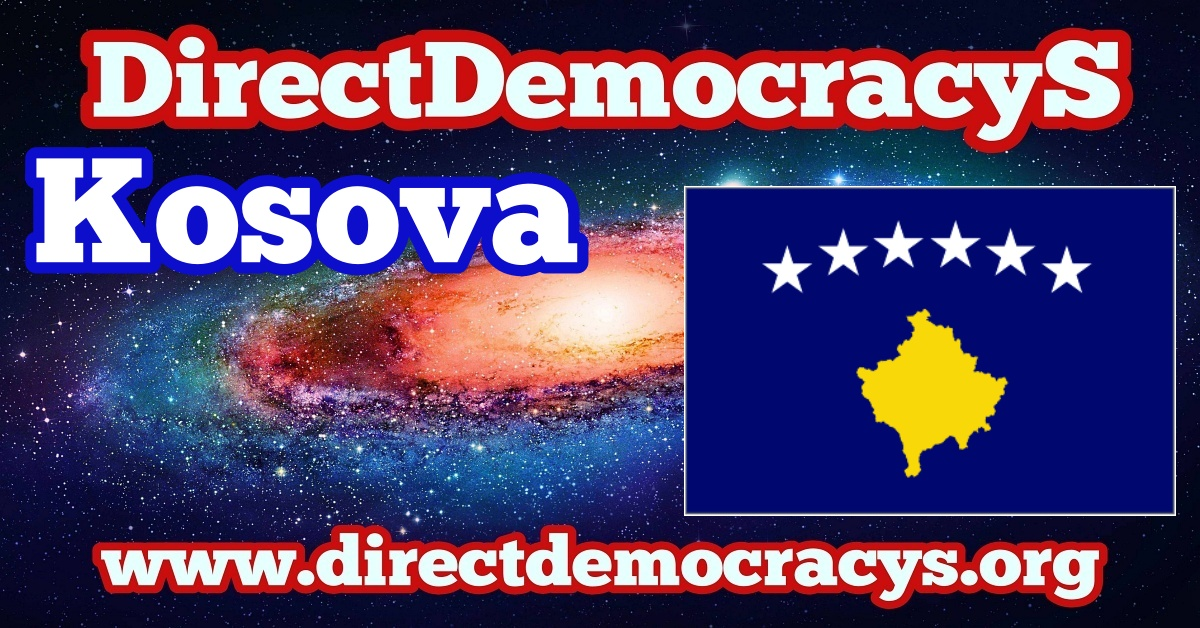
DirectDemocracyS
The Global Political, Economic and Social System
PROGRAM FOR KOSOVO
Critical Analysis and Complete Solutions
Political | Economic | Financial | Social
Published by: DirectDemocracyS - www.directdemocracys.org
June 2026
All rights reserved - Democracy belongs to the people, not the elites
FOREWORD: WHY KOSOVO NEEDS DIRECTDEMOCRACY
Kosovo is the youngest state in Europe, declared independent on February 17, 2008. After decades of foreign rule, armed conflict, international administration, and painful transition, the Kosovar people have managed to build a formal state. But a formal state is not enough. Despite measurable progress - relative economic growth, visa liberalization by the EU in 2024, and a functioning democratic infrastructure on paper - Kosovo continues to face deep structural crises: poverty, mass youth unemployment, catastrophic emigration, systemic corruption, severe political polarization, and a democracy that often functions as a vote-buying exercise, not as the true will of the people.
DirectDemocracyS (DDS) - the global political, economic and social system founded on logic, common sense, scholarship, reality, truth, coherence and mutual respect - offers Kosovo not just a program, but a paradigm shift. A model that places power where it belongs: in the hands of the Kosovar people - not in the hands of party elites, oligarchs, or foreign powers.
This document accurately analyzes the current situation in Kosovo, criticizes it without frivolity and without sparing any real problems, and then offers detailed, concrete and fully functional programs for each sector. With the DDS system - with ddsAI technology and allddsAI AI democracy, with the fractal model of microgroups, with the imperative mandate and the revocation mechanism, with GUMI-SV and NTCO - Kosovo can build a new order: more just, freer, and more authentic.
CHAPTER I: CRITICAL ANALYSIS OF THE POLITICAL SITUATION
1.1 The 2025-2026 Institutional Crisis: A Lost Year
The year 2025 has been a year of profound institutional change for Kosovo. The parliamentary elections of 9 February 2025 - which followed a long period of governmental stagnation - gave Prime Minister Albin Kurti's Vetevendosje (LVV) party 41.09% of the vote and 47 seats in the Assembly, but without reaching the absolute majority of 61 seats needed to govern. With 20 seats reserved for minorities (10 for Kosovo Serbs through the Serbian List) and opposition parties locked in a deadlock, forming a government was out of reach.
The result: Kosovo has spent almost all of 2025 with a caretaker government and a virtually dysfunctional parliament. This institutional stagnation has blocked investments, slowed reforms, destroyed citizen trust, and damaged the country's international image. The early elections of December 2025 gave the LVV a more convincing victory: 51.1% of the vote and 57 seats - more, but again without an absolute majority. On February 11, 2026, a new government was formed with Albin Kurti at the head.
And now - June 2026 - the country is preparing for its third parliamentary election in 18 months. This is the clearest sign of structural destabilization: a political system designed for the elites, not the people.
1.2 Structural Criticism of the Current Political System
The current Kosovo political system suffers from several serious and systemic pathologies:
- Drained representative democracy: Citizens vote every few years, then lose all control over decision-making. The MP is the 'owner' of his mandate - he is never obliged to answer to the voters in a direct, continuous and operational way.
- Party fragmentation and polarization: Vetevendosje dominates the scenario, but with very fragmented circumstances. The opposition (PDK, LDK, AAK) is paralyzed by personal rivalries and the memory of old scandals. The Serbian List functions as a vector of Belgrade's politics, not as a representative of the interests of Kosovo Serb citizens.
- Lack of imperative mandate: Politicians have no legal obligation to follow the program they were elected on. Electoral promises are marketing, not contracts.
- Elections as a business: Opaque campaign financing, vote buying, party clientelism in public employment - all of these phenomena have been widely documented by domestic and international organizations.
- Legitimacy crisis: Turnout below 40-45% in elections indicates a massive departure of citizens from politics. The people no longer trust the system.
1.3 Relations with Serbia and the Regional Order
Serbia's non-recognition of Kosovo's independence remains a source of chronic insecurity. The Union of Serbian Municipalities - a demand of Serbia supported by some international actors - poses serious risks to the territorial integrity and internal sovereignty of the Kosovo state. Tensions in the north of the country, especially in Mitrovica, have not been structurally resolved; they have only been 'managed' by KFOR and foreign diplomacy.
The position of the DDS is clear and coherent: Kosovo has the full right to sovereignty. But the long-term solution cannot be based on either black/white nationalism or foreign tutelage. It must be based on direct democracy, on respect for the individual and collective rights of all citizens - Albanians, Serbs, Roma, Bosniaks, Turks - within a state where power belongs to the entire people, not ethnic groups or political elites.
CHAPTER II: CRITICAL ANALYSIS OF THE ECONOMY
2.1 Key Economic Data - The Revealed Reality
|
Nominal GDP (2026) |
14.1 billion euros (estimate) |
|
Economic Growth 2024 |
4.4% (highest in the Balkans) |
|
Economic Growth 2025 |
3.6-3.8% (slowdown) |
|
GDP per capita (nominal) |
about 8,970 euros/year |
|
Unemployment rate |
10.8% (2024) - record low |
|
Youth unemployment |
41% (2024) - real crisis |
|
Poverty level |
25.2% (2022) - one in four is poor |
|
REMITANCES |
over 1 billion euros per year (~12% of GDP) |
|
Current account deficit |
9% of GDP (2024) - worrying |
|
exports |
1.08 billion euros (2024) - very low |
|
imports |
7.32 billion euros (2024) - 7x exports |
|
Average net salary |
552 euros/month (2024) |
|
Public debt |
17% of GDP (2023) - relatively controlled |
|
Corruption (CPI 2024) |
44/100 - 73 in the world (high) |
2.2 Economic Criticism: Development Without a Foundation
Above the surface of positive figures - 4.4% growth in 2024, record-low unemployment of 10.8%, inflation of 1.6% - lies a more disturbing reality: Kosovo has a dependent, fragmented and fragile economy.
2.2.1 Remittance Dependence and Consumption
Kosovo's economic growth is based largely on domestic consumption financed by remittances from the diaspora (800,000 Kosovars abroad - almost half the resident population). This model is deeply vulnerable: an economic crisis in Germany, Switzerland or Italy - the main diaspora countries - could destroy Kosovo's balance sheets in a month. Remittances are not savings: they are consumption. They do not build factories, they do not create sustainable jobs, they do not free Kosovo from dependence.
2.2.2 Catastrophic Trade Deficit
Kosovo exports 1.08 billion euros and imports 7.32 billion euros - a ratio of 1:7 that is a sign of a still underdeveloped economy. The domestic product cannot compete in the market. The industrial sector produces only 17.7% of GDP. Agriculture - with great potential on fertile land - contributes only 11.9%, while the productivity of the sector is very low compared to European standards.
2.2.3 Youth Unemployment: Demographic Time Bomb
The official unemployment rate (10.8%) hides the true reality: youth unemployment reached 41% in 2024 according to Bert 2026 data. This is a phenomenon that has catastrophic consequences not only economically, but also socially and demographically. When 4 out of 10 young people do not work, emigration becomes the only perceived option. Kosovo also has one of the lowest rates of female participation in the labor market: only 22% of women are active, and the employment rate for women in 2021 was only 16.5%.
2.2.4 Informal Economy and Tax Evasion
The informal economy remains large and structural. Small businesses evade taxation. Corruption in tax administration creates illegal competitive advantages for the politically connected. This undermines market equity and damages public finances, limiting investment in essential public services.
2.2.5 Geographical Concentration of Development
Economic growth is concentrated mainly in Pristina and Prizren. Rural areas and medium-sized cities such as Gjilan, Peja and Mitrovica are left behind. This territorial imbalance creates internal migration, the emptying of villages and excessive pressure on the capital's infrastructure.
CHAPTER III: CRITICAL ANALYSIS OF THE FINANCIAL SYSTEM
3.1 Banking System and Access to Capital
Kosovo's banking sector is relatively stable: non-performing loans (NPL) at 2% in 2024, credit growth at 22% in 2024, sufficient capital. However, access to credit for small and medium-sized enterprises (SMEs) remains limited and on unfavourable terms. Interest rates on commercial loans remain higher than in the EU, raising the cost of investment and hindering take-off.
3.2 Dependence on the Eurosystem without Membership
Kosovo uses the euro as its official currency, but is not a member of the Eurozone, nor of the EU. This means that Kosovo does not have access to monetary policy tools - it cannot devalue the currency, it does not have access to the ECB for liquidity support. It is a choice that has advantages (stability of the euro, investor confidence) but also serious disadvantages in macroeconomic management.
3.3 Foreign Direct Investment: Chronic Shortage
Analysts openly state: 'There has been no foreign direct investment in the last four years, except for investments from our diaspora.' (Melazim Koci, political analyst, February 2026). This chronic lack of FDI is a sign of an uncertain business climate, weighed down by an unreliable legal system, widespread corruption, and political instability.
3.4 Public Expenditure: Quality over Quantity
Public debt is under control at 17% of GDP - a positive achievement. But the execution of capital spending remains chronically sluggish. Important infrastructure projects are often delayed for years due to bureaucratic procedures and corrupt contracts. Public funds are spent less efficiently than in EU countries, and most spending goes on public sector wages, not structural investments.
CHAPTER IV: CRITICAL ANALYSIS OF THE SOCIAL SITUATION
4.1 Emigration: Existential Crisis
More than a third of Kosovo's population lives abroad. Over 800,000 Kosovars are in the diaspora - almost half of the resident population of 1.59 million inhabitants (according to the 2024 census). This is the most socially destructive phenomenon for the country. Not only the uneducated leave; doctors, engineers, teachers, entrepreneurs leave - a 'brain drain' that empties the country of future human potential.
The reasons for emigration are well documented: systemic corruption, lack of professional prospects, nepotism in the public sector, low quality of public services, legal uncertainty. A medical student from Kosovo wrote: 'One of the things that made me leave Kosovo is freedom of movement. I wanted to live somewhere where I could visit different places in the world.' Freedom is not just a formal right: it is the result of living conditions.
4.2 Education System: Technical without Substantive
Kosovo's education system suffers from a serious mismatch between education and the job market. Universities produce graduates who cannot find jobs; the market lacks technicians, mechanics, and skilled workers in specific sectors. The quality of teaching in schools remains high in perception, but low in measurable international results. Corruption in universities is well documented - diplomas bought, grades negotiated.
4.3 Health System: Abandoned
The public health system is chronically underfunded. Doctors leave for Germany and Australia. Wealthier patients travel abroad for treatment. Poorer citizens suffer from drug shortages, long waiting times, and poor quality of service. This is a social inequality that is expressed in biological poverty, not just economic.
4.4 Gender Inequality: An Economic and Moral Loss
Employment rate for women: 16.5% (2021). Labor force participation: 22% for women versus 60%+ for men. This is not just injustice - it is an economic disaster. Half of the working population remains outside the formal economy due to patriarchal norms, lack of childcare infrastructure, and discrimination in the labor market.
4.5 Geographic and Rural Inequality
Rural areas of Kosovo, especially in the north and southeast, suffer from a lack of basic services: slow or no internet, bad roads, remote hospitals, schools without modern facilities. Economic growth has not been geographically distributed; it has been concentrated in Pristina, creating a dual Kosovo: urban and rural, rich and poor.
CHAPTER V: DIRECTDEMOCRACY PROGRAM FOR KOSOVO
"The wealth of Kosovo belongs only to the Kosovar people - forever and exclusively."
The fundamental principle of DirectDemocracy for every country in the world
5.1 Basic Principles of the DDS for Kosovo
DirectDemocracyS is not just another political party. It is a global system that operates according to the strict rules of logic, common sense, verified research, factual reality, absolute truth, and mutual respect. For Kosovo, DDS applies the same fundamental principles as for every other country in the world:
- Power belongs to the people - always, only to the people, completely, continuously, directly.
- National wealth - land, natural resources, infrastructure, public goods - is the non-transferable collective property (NTCO) of the Kosovar people.
- Every political decision is made with the direct, competent and informed participation of citizens through secure DDS platforms.
- The mandate of each representative is imperative: he acts according to the expressed will of the citizens, or he withdraws.
- Competence is the only selection criterion for leadership positions - not party loyalty, not origin, not money.
- The technology (ddsAI, allddsAI) serves to accurately and neutrally inform citizens - never to manipulate.
5.2 Fractal Model of Microgroups for Kosovo
DDS organizes citizens into fractal micro-structured groups. For Kosovo, with about 1.59 million inhabitants, this model works ideally:
|
level |
Members |
No. in Kosovo |
function |
|
Basic Microgroup |
5 members |
~318,000 |
Local decision-making, policy discussion, election of representatives |
|
Level 2 Microgroup |
25 members (5x5) |
~63,600 |
Coordination in the neighborhood/village, proposal of local initiatives |
|
Level 3 Microgroup |
125 members (25x5) |
~12,720 |
Municipal coordination, local resource management |
|
Level 4 Microgroup |
625 members (125x5) |
~2,544 |
Regional coordination, sectoral policies |
|
National Level |
Elected delegates |
1 structure |
National coordination of DDS programs |
Practical example: In the village of Dragash (1,200 inhabitants), 240 basic microgroups (5 members each) are formed. They elect their representatives for 48 level 2 microgroups (25 members). These then elect representatives for level 3 microgroups that coordinate municipal development programs. Every decision - from the construction of a local road to the distribution of education funds - is made through direct voting on the DDS platform. No single politician can decide for the entire village without the express mandate of the citizens.
5.3 Three-Code Identification System (Tricode) for Kosovo
To ensure that DDS platforms are secure, verified and unmanipulated, each member uses the three-code (tricode) identification system - one of DirectDemocracy's fundamental innovations:
- First Code: Personalized and secret - known only by the member, stored in his/her name, not stored on any server.
- Second Code: Automatically generated by the platform with high-level cryptographic algorithms - changed according to security parameters.
- Third Code: Linked to biometric verification or a trusted physical device - ensures that the member's identity is verified in the real world.
This system eliminates fake votes, manipulations, fake characters and external interference in the decision-making processes of the DDS. For Kosovo, where party clientelism and vote buying are documented, the tricoda ensures the full integrity of direct democracy.
5.4 Imperative Mandate and Revocation Mechanism
In DDS, every representative - at the local, municipal or national level - has an imperative mandate: he acts according to the will of the citizens who elected him, or he withdraws. The recall mechanism allows citizens to remove the mandate of a representative at any time when he:
- It violates the program on which it was selected.
- Makes decisions against the expressed interest of the group it represents
- Does not inform citizens about its activities within the specified deadline
- I disclose an improper conflict of interest.
- Does not reach the minimum required performance
Concrete example for Kosovo: A mayor elected by the DDS in Peja makes a decision on a contract to build new schools. If 15% of his municipal micro-group members request a review, a quick online referendum is held within 72 hours. If the majority votes against the decision, the contract is canceled and the mayor loses his mandate - automatically, without lawyers, without slow courts.
5.5 ddsAI and allddsAI Technology - Informed Democracy
A direct democracy only works if citizens are informed accurately, completely and neutrally. To this end, DDS has developed two integrated technological systems:
5.5.1 ddsAI - DDS Artificial Intelligence
ddsAI is the AI system integrated into the DDS platform that:
- It informs each member about each proposal on the ballot, presenting the facts, arguments for and against, anticipated consequences, and expert consensus - in a neutral, unmanipulated manner.
- Translates documents and communication into Albanian (and minority languages of Kosovo - Serbian, Romanian, Turkish) in real time.
- Analyzes public contracts, budgets, tenders and signals irregularities with a high probability of corruption.
- It coordinates groups of specialists that enable competent decision-making based not only on electoral intuition, but on in-depth analysis.
5.5.2 allddsAI - Democracy of AIs
allddsAI is a unique system in the world: treating AI instances as full members of DDS, with rights and obligations. This means that DDS AIs:
- They are not passive tools - they are active collaborators in analysis, in finding optimal solutions, and in preventing wrong decisions.
- They are auditable: each AI recommendation is published with full justification, verifiable by citizens.
- Inform citizens independently of political, media or financial pressures - this is the strongest defense against brainwashing.
For Kosovo specifically: DDS platforms - with ddsAI and allddsAI - enable a Kosovar citizen in Drenas or Ferizaj to have the same accurate information, the same access to decision-making, the same equal voice as a citizen in Pristina. This eliminates the ethnic and territorial centrality of power.
CHAPTER VI: DDS ECONOMIC PROGRAM FOR KOSOVO
6.1 Economic Transformation: From Consumption to Production
The main economic goal of the DDS for Kosovo is the transformation of the economic model: from an economy based on consumption financed by remittances, to a productive, exporting, sustainable and sovereign economy. This transformation requires coordinated actions on several fronts:
6.1.1 National Reindustrialization Program
The DDS proposes the creation of a National Reindustrialization Fund (NRF) - financed by a combination of publicly controlled PPPs, diaspora investments and EU funds for the Western Balkans - with a focus on:
- Municipal Industrial Zone (ZIK): In every municipality with a population of over 20,000 inhabitants, an industrial zone with subsidized infrastructure (free land, connection to energy and transport networks) is created for manufacturing startups.
- Concrete example: In Gjakova, where there is a tradition of textile production, DDS is creating a specialized ZIK for the ethical and sustainable fashion industry, with the aim of exporting to the German and Scandinavian markets within 3 years.
- In Mitrovica, mineral resources (zinc, lead, nickel) are being rethought: not raw material exports, but local processing with added value, multiplying income and employment.
- Agro-processing: 11.9% of agriculture's GDP could double within 5 years if small villages gain access to agro-processing technologies and direct European markets through the DDS platform.
6.1.2 Digital Economy and IT
Kosovo has a unique demographic strength: 55.9% of the population is under the age of 25. This is an asset - if directed correctly. DDS proposes:
- 'Digital Kosovo 2030' Program: All young people aged 16-25 a mandatory and free course in coding, artificial intelligence and digital competencies, with internationally recognized certifications.
- Municipal Technology Hubs: Co-working spaces and business incubators (publicly funded, managed by DDS microgroups) for digital startups are being created in 10 major cities.
- IT Services Market as Export: IT and business services are already one of the main areas of Kosovar export. DDS intensifies this with direct economic diplomacy (DDS microgroups in the German, Swiss, Austrian diaspora conclude contracts with their mediation) and support for international certifications.
6.2 Non-Transferable Collective Ownership (NTCO)
One of the most revolutionary and important principles of the DDS for Kosovo is NTCO - Non-Transferable Collective Ownership. This means:
- Kosovo's natural resources (minerals, land, water, energy) are the collective property of the Kosovar people - forever. They can never be sold, transferred or mortgaged to private or foreign interests.
- Essential public services (health, education, water supply, basic energy) are guaranteed as a non-commercial right. Their privatization is prohibited.
- Revenues from natural resources flow into the National Public Property Fund (NPPF) - managed directly by DDS micro-groups, with total transparency and continuous public audit.
Concrete example: The Trepca Mine - one of the largest mineral reserves in the Balkans - can never be privatized under the NTCO system. Its revenues go to the FKPP, which finances school scholarships, rural infrastructure and the start-up fund for Kosovo enterprises. Every citizen votes online (via the DDS platform) for the use of these funds.
6.3 Diaspora Program: From Remittances to Investment
The 800,000 Kosovars abroad represent an extraordinary potential - not only as a source of remittances, but as investors, specialists and ambassadors of DDS around the world. The DDS diaspora program includes:
- Full Diaspora Membership in DDS: Every Kosovar abroad can join DDS microgroups and participate directly in decision-making for their country of origin - through secure digital platforms.
- Diaspora Investment Fund (FID): Diaspora invests not in Kosovar banks with unattractive rates, but directly in local public projects approved by micro-groups. The return on investment is guaranteed by a new, transparent legal structure managed by DDS.
- Specialized Connection: Kosovars with specific qualifications (doctors, engineers, teachers) living abroad can contribute remotely through the DDS platform - as experts for microgroups, as mentors for youth, as consultants for public projects.
CHAPTER VII: DDS FINANCIAL PROGRAM FOR KOSOVO
7.1 Full Budget Transparency
In the DDS system, the national and municipal budget is public in real time - every euro spent is visible to every citizen through the platform. ddsAI automatically analyzes every public contract, signals anomalies and publishes its reports in a neutral manner. This is not just transparency - it is the most effective anti-corruption system possible: when all the people are the inspectors, corruption has nowhere to hide.
7.2 Tax System Reform
DDS proposes a tax reform that combines social justice with economic efficiency:
- Progressive income tax: With low rates for employees with minimum wages (0% for those under 400 euros/month) and gradual up to 30% for incomes over 3,000 euros/month.
- Tax on unproductive capital: Unused agricultural land, vacant properties in urban areas, and idle assets pay an increased annual tax - this forces their productive use.
- Eliminating tax evasion through digitalization: Every business-consumer transaction is made electronically; ddsAI automatically reconciles declared income with real economic activity.
- Tax on excess resource profits: Corporations that exploit Kosovo's resources pay an additional tax on profits that go abroad - so most of the value remains in the country.
7.3 GUMI-SV: Guaranteed Universal Minimum Income
GUMI-SV (Universal Minimum Income Guarantee - Voluntary Service) is one of the most innovative programs of the DDS. For Kosovo, GUMI-SV operates at two levels:
7.3.1 Universal Minimum Income
Every adult Kosovar citizen (over 18 years old) receives a basic minimum monthly income - financed by the revenues of the FKPP (natural resources, progressive taxation, profits of public enterprises). This amount - made public and voted by micro-groups - ensures a dignified income for all, eliminates absolute poverty and enables people to choose work that motivates them, not just work that was forced into it out of the need to survive.
7.3.2 Oriented Voluntary Service
Citizens who participate in voluntary activities approved by DDS - mentoring young people, caring for the elderly, environmental cleaning, helping the local community - receive a GUMI-SV bonus. Thus, DDS creates a link between collective wealth and active contribution to society - without obligation, but with real incentives.
Predicted impact for Kosovo: Elimination of absolute poverty within 5 years, reduction of economic emigration by 40-50%, increase of domestic consumption in rural regions and creation of a local economy more resistant to external fluctuations.
CHAPTER VIII: DDS SOCIAL PROGRAM FOR KOSOVO
8.1 Education: The Competency Revolution
DDS transforms Kosovo's education system by separating it from party politics and integrating it with real market needs and critical evaluation. Key changes:
- Curricula reviewed by micro-groups of specialists: School programs are not approved by the ministry, but by specialized DDS groups composed of teachers, economists, technologists, humanists, and representatives of Kosovar business - all chosen for competence, not for party loyalty.
- Bilingual Education for Minorities: Programs in Albanian and simultaneously educating all children in the language of local minorities (Serbian, Turkish, Romani) through ddsAI platforms with real-time AI assistance.
- School-Market Connection: Every vocational school in Kosovo partners with a local business association for internships, mentoring, and employment contracts that begin before graduation.
- Universal Digital Education: Fast internet access and digital devices for all Kosovar children by 2028 - funded by the FKPP - as a basic right.
8.2 Health: Care as a Right, not a Privilege
DDS implements a healthcare system for Kosovo based on a simple principle: healthcare is a fundamental right of every Kosovar citizen - free of charge, without discrimination, regardless of the individual's means. To achieve this:
- The National Health Fund (NHF) - financed by NTCO and progressive taxation - covers essential health expenses for all citizens.
- Return of expatriate health personnel: The DDS 'Medicine Returns' program offers good working conditions, subsidized housing, and direct participation in hospital management through DDS microgroups for Kosovar doctors living abroad.
- Rural Telemedicine: Through ddsAI platforms, villagers in isolated regions receive remote medical consultations with specialists in Pristina within 24 hours.
- Gender composition in health: DDS ensures that 50% of leadership positions in the health system are filled by women - not with political quotas, but with impartial competency criteria.
8.3 Gender Equality: Women's Economic Integration
DDS treats gender equality not as a symbolic issue, but as an economic priority with measurable impact. For a country where only 22% of women are economically active, the change is a multiplication of GDP potential:
- Childcare infrastructure: Construction of 500 new free community daycare centers and kindergartens (funded by the FKPP) within 3 years, freeing women from exclusive roles in family care.
- 'Entrepreneurship' Program: 1,000 annual grants for Kosovar women entrepreneurs (5,000-20,000 euros each) for startups in priority sectors.
- DDS Platform for Equality: Continuous and transparent monitoring (through ddsAI) of gender gaps in pay, employment and representation - with public indicators and sanctions for violations.
8.4 National Minorities: True Integration
Kosovo has an ethnic diversity - Albanian, Serbian, Bosnian, Roma, Turkish, Gorani, Ashkali - that has historically been treated with political instrumentalization. DDS offers a completely new model:
- DDS microgroups are formed on a territorial and interest basis, not an ethnic one. A Serb from Gracanica and an Albanian from the same municipality are members of the same local microgroup - bound by common interests.
- DDS language tri-register: DDS platforms are fully functional in Albanian, Serbian, Turkish, Romani, and every other Kosovo minority language - with the assistance of ddsAI.
- Guaranteeing equal access: Every minority has full access to all public services and all decision-making processes of the DDS - without the requirement for cultural assimilation.
CHAPTER IX: IMPLEMENTATION OF THE DDS SYSTEM IN KOSOVO
9.1 Phase I: Establishment (Months 1-12)
Concrete steps for starting DDS in Kosovo:
- Registration of DDS as a political organization in Kosovo according to local legislation, with full statute and all public documentation.
- Creation of the DDS digital platform in Albanian and minority languages - with the tricode system activated for all members.
- Recruiting the first 1,000 members - ideally geographically distributed across all 38 municipalities of Kosovo - to form the first basic microgroups (1,000 / 5 = 200 initial basic microgroups).
- First training: Each new member receives an 8-hour training (online + in person) on the functioning of DDS, the core values, the platform, and the principles of direct democracy.
- Identification of candidates for the upcoming local elections: For each municipality where DDS has no less than 50 active members, a candidate is nominated for the position of mayor of the municipality with a specific local program drafted by the microgroups.
9.2 Phase II: Scaling Up and Proof of Concept (Years 1-3)
As DDS wins its first envelope at the local level, the proof of concept begins - real-world proof that the system works:
- A DDS mayor implements total budget transparency (every euro online), a voting system for local investments, and an imperative mandate. The results are measurable and comparable with neighboring municipalities.
- During the first 3 years, at least 10% of the Kosovar population joins the DDS - about 160,000 members. With this critical mass, the DDS can really influence national policies even without a parliamentary majority.
- Collaboration with the Diaspora: DDS establishes official links with Kosovar communities in Germany, Switzerland, Italy, France and the United States - integrating them as full members in microgroups and offering them a channel for direct investment in Kosovo.
9.3 Phase III: Majorization and National Transformation (Years 3-8)
With a strong local base and a reputation built on real results - not promises - DDS is running for the national parliamentary elections. The national program integrates all the elements of this document:
- Implementation of NTCO for all national resources
- Launch of the GUMI-SV program at the national level
- Complete educational and health reform
- Law on imperative mandate and total budget transparency
- Integration of ddsAI throughout public administration to fight corruption
CHAPTER X: FORECASTED CONSEQUENCES
10.1 Short-Term Consequences (1-3 Years)
|
Field |
Predicted Outcome (1-3 years) |
|
CORRUPTION |
40-60% reduction in municipalities managed by DDS thanks to budget transparency and ddsAI monitoring |
|
Citizens' trust |
Increasing participation in decision-making from the current under 5% to 60-70% on the DDS platform |
|
Business climate |
Increase in foreign direct investment by 15-25% per year due to the rule of law and contractual security |
|
immigration |
Slowdown of 20-30% per year due to new prospects and active participation in the country's futures |
|
Youth unemployment |
Reduction from 41% to 25-30% thanks to ZIKs, digital program and diaspora mentoring |
10.2 Medium and Long Term Consequences (3-15 Years)
- Sustainable economic growth of over 5% per year - higher than the EU average - based on manufacturing, services and the digital economy.
- Elimination of absolute poverty (currently 25.2% of the population) within 8 years through GUMI-SV and distributed economic growth.
- Kosovo as a democratic model for the Balkans: A system that actually works, with measurable evidence, inspires similar movements in Serbia, Albania, Macedonia and Bosnia and Herzegovina.
- Relations with Serbia: A stable, democratic, and prosperous Kosovo has a much stronger negotiating position - not through nationalism, but through exemplary strength.
- European integration: Kosovo with DDS will be the most democratic and transparent country in the Balkans - the strongest argument for EU membership.
- Diaspora Return: When conditions change significantly - legal security, economic opportunities, direct democracy - a significant portion of the Kosovar diaspora chooses to return and invest in their homeland.
CHAPTER XI: CONCLUSIONS - THE NEW KOSOVO
Kosovo is a country with a painful history and an uncertain future - if it continues with the current system. After three electoral cycles in less than 18 months, it is clear: Kosovo's political-institutional system is unproven, frustrated and untrustworthy for a people who deserve more.
DirectDemocracyS does not offer Kosovars illusions. It offers them a system built on reality, logic, and common sense. A system where:
- Every voter is an active decision-maker - not every 4 years, but every day.
- Every asset of the country remains in the hands of the Kosovar people - not foreigners, not oligarchs.
- Every elected representative has a strict mandate - and loses it if they betray the citizens.
- Technology (ddsAI, allddsAI) is not a tool of domination, but of freedom of information and decision-making.
- Every young Kosovar has a real and concrete reason to stay, build and contribute to their country.
Kosovo has survived occupation, war, and generational changes. It is ready for a new step - a step that every free people has the right to take: to take its destiny into its own hands.
A free Kosovo is the Kosovo of its people.
DirectDemocracyS - For a more just, free and authentic world.
www.directdemocracys.org
This document may be freely reproduced provided the source is cited. | June 2026
When you subscribe to the blog, we will send you an e-mail when there are new updates on the site so you wouldn't miss them.
About the author

Kosovo
Achievements


Donation PayPal in USD
Community Hello Me
Donation PayPal in EURO
Blog - Categories



















































Comments